D-Biotin literature
SYSTEMS AND METHODS FOR DETECTION OF TARGET ANALYTES USING SELECTIVELY CLEAVABLE BONDS
-
, (2021/09/10)
The invention described herein is directed to methods of isolation and detection of target analytes in a sample. The target analytes are coupled to analyte detection particles which comprise base particles having labels and affinity agents coupled thereto by linker arms. The linker arms form bonds with the labels and target analytes and are cleavable under different label and affinity cleavable conditions. Systems and methods for preparing and using the analyte detection particles are also disclosed.
Solution Dynamics of Hybrid Anderson-Evans Polyoxometalates
Salazar Marcano, David E.,Lentink, Sarah,Moussawi, Mhamad A.,Parac-Vogt, Tatjana N.
supporting information, p. 10215 - 10226 (2021/05/31)
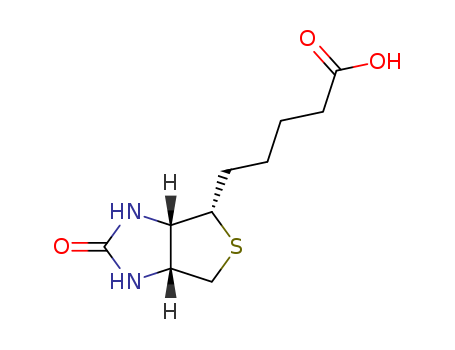
Understanding the stability and speciation of metal-oxo clusters in solution is essential for many of their applications in different areas. In particular, hybrid organic-inorganic polyoxometalates (HPOMs) have been attracting increasing attention as they combine the complementary properties of organic ligands and metal-oxygen nanoclusters. Nevertheless, the speciation and solution behavior of HPOMs have been scarcely investigated. Hence, in this work, a series of HPOMs based on the archetypical Anderson-Evans structure, δ-[MnMo6O18{(OCH2)3C-R}2]3-, with different functional groups (R = -NH2, -CH3, -NHCOCH2Cl, -NCH(2-C5H4N) {pyridine; -Pyr}, and -NHCOC9H15N2OS {biotin; -Biot}) and countercations (tetrabutylammonium {TBA}, Li, Na, and K) were synthesized, and their solution behavior was studied in detail. In aqueous solutions, decomposition of HPOMs into the free organic ligand, [MoO4]2-, and free Mn3+ was observed over time and was shown to be highly dependent on the pH, temperature, and nature of the ligand functional group but largely independent of ionic strength or the nature of the countercation. Furthermore, hydrolysis of the amide and imine bonds often present in postfunctionalized HPOMs was also observed. Hence, HPOMs were shown to exhibit highly dynamic behavior in solution, which needs to be carefully considered when designing HPOMs, particularly for biological applications.
METHOD FOR PRODUCING BIOTIN
-
Paragraph 0067-0083, (2021/02/25)
To provide a production method for obtaining high-purity biotin at good yields.SOLUTION: A method for producing biotin includes a process in which a composition comprising biotin represented by the formula (I) is brought into contact with hydrosulfite salt, before the biotin is extracted.SELECTED DRAWING: None
Selective modification of sulfamidate-containing peptides
Busto, Jesús H.,Jiménez-Osés, Gonzalo,Mazo, Nuria,Navo, Claudio D.,Peregrina, Jesús M.
supporting information, p. 6265 - 6275 (2020/09/07)
Hybrid peptides whose N-terminal residues are activated in the form of α-methylisoserine-derived cyclic sulfamidates exhibit rich reactivity as electrophiles, allowing site- and stereoselective modifications at different backbone and side chain positions.