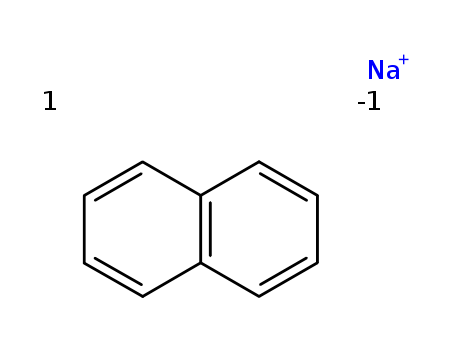
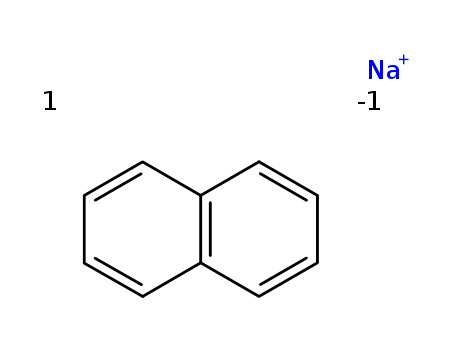
sodium naphthalide literature
O -Functionalization of a cobalt carbonyl generates a terminal cobalt carbyne
Deegan, Meaghan M.,Peters, Jonas C.
supporting information, p. 9531 - 9534 (2019/08/15)
Despite efforts toward extending multiple bonding motifs to late metal systems, examples of late transition metal carbynes remain scarce. Herein, we describe the synthesis of a series of L3Co(CO) complexes supported by a trisphosphine ligand framework, with the most reduced of these complexes being amenable to O-functionalization. This transformation provides access to the second reported example of a terminal Co-carbyne complex, in this case stabilized in a pseudotetrahedral geometry (i.e., L3CoC-OSiR3). Its geometry makes its electronic structure suitable for comparison to structurally-related examples of terminal Co-imido and oxo species.
Exploiting Charge-Transfer States for Maximizing Intersystem Crossing Yields in Organic Photoredox Catalysts
Sartor, Steven M.,McCarthy, Blaine G.,Pearson, Ryan M.,Miyake, Garret M.,Damrauer, Niels H.
supporting information, p. 4778 - 4781 (2018/04/17)
A key feature of prominent transition-metal-containing photoredox catalysts (PCs) is high quantum yield access to long-lived excited states characterized by a change in spin multiplicity. For organic PCs, challenges emerge for promoting excited-state intersystem crossing (ISC), particularly when potent excited-state reductants are desired. Herein, we report a design exploiting orthogonal π-systems and an intermediate-energy charge-transfer excited state to maximize ISC yields (ΦISC) in a highly reducing (E0? = -1.7 V vs SCE), visible-light-absorbing phenoxazine-based PC. Simple substitution of N-phenyl for N-naphthyl is shown to dramatically increase ΦISC from 0.11 to 0.91 without altering catalytically important properties, such as E0?.
A Gold Carbene Manifold to Prepare Fused γ-Lactams by Oxidative Cyclisation of Ynamides
Sánchez-Cantalejo, Fernando,Priest, Joshua D.,Davies, Paul W.
supporting information, p. 17215 - 17219 (2018/11/10)
Gold-catalysed oxidative cyclisation reactions of ynamides offer great promise in γ-lactam synthesis but are limited by preferential over-oxidation to form α-keto imides. Evaluating the factors that might limit N-cyclisation pathways led to effective gold-catalysed conditions that allow access to different fused γ-lactams on changing the ynamide N-substituent and accommodate previously incompatible substitution patterns. New and efficient methods for the synthesis of functionalised 3-aryl indoles and cyclohepta[c]pyrrol-1-one derivatives are presented. These conditions illustrate the complementarity of gold catalysis to other metals.
Formal Synthesis of Bioactive Indole Alkaloids Eburnamonine, Eburnaminol, and Vindeburnol
Mondal, Pravat,Argade, Narshinha P.
, p. 1849 - 1856 (2017/04/06)
Starting from (±)-3-acetoxyglutarimide, diastereoselective formal synthesis of indole alkaloids (±)-eburnamonine, (±)-eburnaminol, and (±)-vindeburnol have been demonstrated via a common intermediate (±)-1-hydroxy-12-tosyl-2,3,6,7,12,12b-hexahydroindolo[2,3-a]quinolizin-4(1H)-one in very good overall yields. The acetoxy group from (±)-3-acetoxyglutarimide was first used to induce the diastereoselectivity and also as a latent source of ketone carbonyl group. The stereoselective eliminations, reductions, and intramolecular cyclizations were the involved key steps.
sodium naphthalide Upstream and downstream
3481-12-7 Upstream product
-
91-20-3
naphthalene
-
7440-23-5
sodium
3481-12-7 Downstream Products
-
91-20-3
naphthalene
-
7440-23-5
sodium