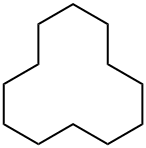
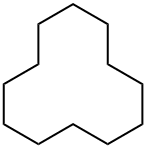
Cyclododecane literature
A novel reaction in ionic liquids: Selective cyclization of 1-dodecene to cyclododecane under moderate pressure
Qiao, Kun,Deng, Youquan
, p. 2191 - 2193 (2003)
A novel reaction of cyclization of 1-dodecene to cyclododecane with high selectivity, especially under moderate pressure, is found in ethanol buffered chloroaluminate ionic liquids with easy separation of product due to the immiscibility with ionic liquids.
Diastereomeric cyclic tris-allenes
Mustafa, Hussein H.,Baird, Mark S.,Al Dulayymi, Juma'A R.,Tverezovskiy, Viacheslav V.
, p. 2497 - 2499 (2013)
Both diastereomers of the tris-allene, cyclododeca-1,2,5,6,9,10-hexaene have been obtained using a triple cyclopropylidene-allene rearrangement. On the NMR timescale, one has D3 symmetry, and is the smallest hydrocarbon synthesised to have this symmetry, and the second has C2 symmetry.
5,10-Dihydro-Silanthrene as a Reagent for the Barton-McCombie Reaction
Gimisis, T.,Ballestri, M.,Ferreri, C.,Chatgilialoglu, C.,Boukherroub, R.,Manuel, G.
, p. 3897 - 3900 (1995)
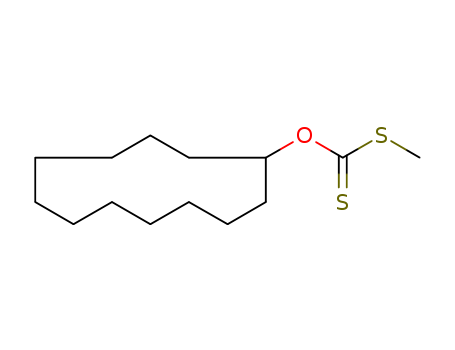
The deoxygenation of secondary alcohols via thionoesters with the use of 5,10-dihydrosilanthrene as the radical reducing agent has been studied in detail.The ability of hydrogen donation of this silane has been measured using the one-carbon ring expansion of 1-(2-oxocyclopentyl)ethyl radical as a timing device.
Discrimination of Rotational Isomeric States in Cycloalkanes by Solid-State CP-MAS 13C NMR Spectroscopy
Moeller, Martin,Gronski, Wolfram,Cantow, Hans Joachim,Hoecker, Hartwig
, p. 5093 - 5099 (1984)
The solid-state behavior of three cycloalkanes, cyclododecane, cyclotetraeicosane, and cyclohexatriacontane, was investigated by means of temperature dependent magic angle cross-polarization 13C NMR experiments.For the two smaller ring molecules a state of high internal mobility like the "rotator phase" in n-alkanes was detected.It could be correlated with a phase transition in the solid state visible by means of DSC.In the case of (CH2)12 this is 151 K below the melting point, and in the case of (CH2)24 it is 25 K below the melting transition.The CP-MAS 13C NMR spectra show a transition from the fast exchange to the slow exchange regime of magnetically nonequivalent states.By comparison with X-ray diffraction data the well-resolved resonance signals for the low-temperature phases were assigned to molecular segments distinguished by the rotational isomeric states of the carbon-carbon bonds.Chemical shift differences due to conformational isomerism were as large as 12 ppm; thus, they exceed "packing effects" by far.
Sustainable System for Hydrogenation Exploiting Energy Derived from Solar Light
Ishida, Naoki,Kamae, Yoshiki,Ishizu, Keigo,Kamino, Yuka,Naruse, Hiroshi,Murakami, Masahiro
supporting information, p. 2217 - 2220 (2021/02/16)
Herein described is a sustainable system for hydrogenation that uses solar light as the ultimate source of energy. The system consists of two steps. Solar energy is captured and chemically stored in the first step; exposure of a solution of azaxanthone in ethanol to solar light causes an energy storing dimerization of the ketone to produce a sterically strained 1,2-diol. In the second step, the chemical energy stored in the vicinal diol is released and used for hydrogenation; the diol offers hydrogen onto alkenes and splits back to azaxanthone, which is easily recovered and reused repeatedly for capturing solar energy.
Hydrogenation of 1,5,9-Cyclododecatriene in a Three-Phase System in the Presence of Nickel Nanoparticles Supported on NаX Zeolite
Nebykov,Popov, Yu. V.,Mokhov,Shcherbakova,Zotov, Yu. L.
, p. 110 - 115 (2021/03/18)
The hydrogenation of 1,5,9-cyclododecatriene in the presence of nanostructured Ni catalysts, supported with NaX zeolite, in a flow-through reactor at atmospheric hydrogen pressure was investigated. Nickel nanoparticles on the support surface were prepared by chemical reduction of the precursor (NiCl2) with NaBH4 and NH2NH2. The effect exerted on the yield of hydrogenation products by the nominal residence time of the gas phase in the reaction zone and by the process temperature was considered, and the catalyst operation life was analyzed. The catalysts showed high activity and allowed preparation of cyclododecane in ~100% yield at a process temperature of up to 160°С.
A New Protocol for Catalytic Reduction of Alkyl Chlorides Using an Iridium/Bis(benzimidazol-2′-yl)pyridine Catalyst and Triethylsilane
Fukuyama, Takahide,Hamada, Yuki,Ryu, Ilhyong
, p. 3404 - 3408 (2021/07/14)
The reduction of alkyl chlorides using triethylsilane is investigated. Primary, secondary, tertiary, and benzylic C-Cl bonds are effectively converted into C-H bonds using an [IrCl(cod)] 2/2,6-bis(benzimidazol-2′-yl)pyridine catalyst system. This catalyst system is quite simple since the tridentate N-ligand can be easily prepared in one step from commercially available reagents.
Flow Chemistry under Extreme Conditions: Synthesis of Macrocycles with Musklike Olfactoric Properties
Seemann, Alexandra,Panten, Johannes,Kirschning, Andreas
supporting information, p. 13924 - 13933 (2021/05/29)
Starting from small cyclic ketones, continuous flow synthesis is used to produce medium-sized rings and macrocycles that are relevant for the fragrance industry. Triperoxides are important intermediates in this process and are pyrolyzed at temperatures above 250 °C. The synthesis is carried out in two continuously operated flow reactors connected by a membrane-operated separator. The practicality of flow chemistry is impressively demonstrated in this work by the use of hazardous reagent mixtures (30% H2O2, 65% HNO3) and the pyrolysis of no less problematic peroxides. All new macrocycles were tested for their olfactory properties in relation to musk.